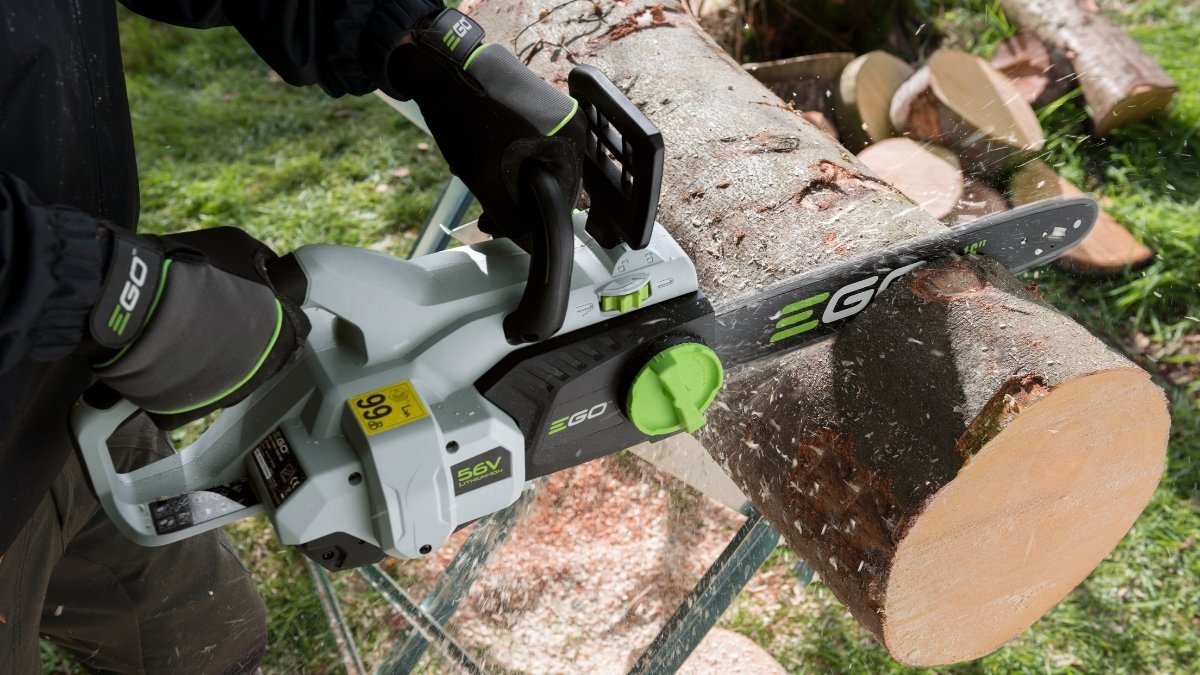
Cutting your own firewood is one of those jobs that feels both practical and strangely satisfying. Stacking a neat pile of logs you have cut yourself, ready for cold evenings, is hard to beat. Doing it the wrong way is where most people get hurt.
In this guide, we walk you through how to cut firewood safely step by step, so you can go from rough logs to ready to burn wood with a lot more confidence and far less risk.
How to cut firewood safely (quick answer)
To cut firewood safely, set up on level ground, wear full PPE, and support each log so it can’t roll or kick out. Use a sharp chainsaw to cut the trunk into short rounds, keeping the chain clear of the ground and letting the saw do the work. Once you have your rounds, split them on a solid chopping block and move them clear of your work area before you start the next cut.
- Prepare your area: Clear branches, tools and offcuts so you have steady footing and room to move.
- Put on PPE: At minimum, use eye protection, gloves, hearing protection, sturdy boots and chainsaw trousers.
- Support the log: Use a sawhorse, log jack or solid supports to hold it steady and lift it away from the ground.
- Cut in stages: Crosscut into rounds first, then split. Don’t try to do everything in one go.
- Look after your tools: Keep the chain sharp, check chain oil and take regular breaks so your technique stays tidy.
What you need before you start cutting firewood
To cut firewood safely, you need three things in place before you start: the right protective gear, a stable work area and tools you can control easily. Before you make a single cut, take a minute to get your set up right.
Personal protective equipment (PPE)
You don’t need to dress like a lumberjack, but you do need proper protection. At a minimum, that means:
- Helmet with visor or safety glasses to protect from flying chips
- Chainsaw gloves for grip and vibration control
- Hearing protection
- Chainsaw trousers with protective fibres
- Sturdy boots with good ankle support and a solid tread
A stable work area
Your cutting area should feel solid and predictable. Aim for flat, clear ground underfoot so you’re not stepping over branches or offcuts. Keep pets, children and curious spectators well away from your workspace. If it’s blowing a gale or the ground’s muddy and slick, wait for better conditions. Good footing does more for safety than any tool upgrade.
Tools that make the job easier
Before you start, make sure you’ve got the following tools:
- A solid sawhorse or log stand so the wood’s lifted off the ground and held steady
- Chain oil and a chain that’s sharp and correctly tensioned
- A splitting tool ready for after you’ve cut your rounds
You can cut firewood with any decent chainsaw, but the job’s far more controlled with the right set up. A cordless chainsaw from the EGO Power+ range is ideal here. They offer plenty of power for firewood, no fumes, much less noise and no pull cord to fight with every time you stop for a break.
Step by step: how to cut firewood safely
Once your work area’s set and the logs are supported, you’re ready to start cutting. Take your time here. Smooth, steady movements are safer and they usually give you better firewood too.
1. Get into a safe stance
Stand with your feet roughly shoulder width apart, one foot slightly forward, so you feel balanced and grounded. Keep the saw close to your body rather than reaching out with straight arms. That gives you more control and makes it easier to react if the wood moves.
Hold the chainsaw firmly with both hands, thumbs wrapped around the handles. Before you start a cut, check again that the log can’t roll and that nothing is in your way if you need to step back.
2. Start the cut gently
Bring the saw up to speed before the chain touches the wood. Let the teeth bite in gently instead of jabbing at the log. For most firewood cuts, you’ll work with the lower part of the bar, not the very tip, and you’ll cut straight down through the log.
Keep the chain clear of the ground. Allow the weight of the saw and the chain speed to do most of the work. If you feel yourself forcing it, stop and check whether the chain needs sharpening.
3. Finish the cut without pinching
As you get close to the end of the cut, be ready for the log to move. If the wood starts to pinch the bar, ease off and change your angle slightly or cut from the opposite side so the kerf can open up rather than close on the chain.
Never twist the bar to free it. If it does get stuck, switch the saw off, wait for the chain to stop, then ease the wood apart or support it differently before you cut again.
4. Clear, stack and move on
Once the round drops, switch the chain off before you move anything. Put the cut piece to one side in a neat stack or into a pile ready for splitting, then check your work area again so there’s nothing to trip on.
Work methodically along the log rather than cutting random sections. It keeps your log lengths more consistent and helps you stay in a rhythm. A cordless EGO Power+ chainsaw really earns its keep here: no fumes, less noise, and fewer cables or pull cords to break your flow.
How to avoid common chainsaw mistakes when cutting firewood
Even experienced users slip into bad habits, and most of the scary moments people have with a chainsaw come from the same handful of mistakes. Avoid these, and your whole session becomes calmer, cleaner and much safer.
Don’t cut on the ground
It’s tempting to take a quick slice off a log that’s lying flat, but this is where chains get wrecked and kickback becomes more likely. Hitting soil, grit or stones will dull your chain instantly, and if the bar tip catches, it can shoot up towards you. Keep the log raised on a stand or supports so the chain stays clear.
Don’t rush the cut
People get hurt when they’re tired or trying to squeeze in “one last log”. If the saw feels like it’s fighting you, stop and reset. A sharp chain and a steady pace do more for safety and speed than any amount of leaning or forcing.
Don’t cut unstable or rolling logs
If the wood’s wobbling, shifting or rocking, fix that before you start. Most bars get pinched because the log wasn’t supported properly, not because of the saw itself. Taking ten seconds to stabilise the log is worth far more than muscling through an awkward angle.
Don’t ignore the tip of the bar
Kickback usually comes from the top corner of the bar making contact with something you didn’t see. Keep that area well clear of branches, supports and the far side of the cut. Being conscious of where the tip of the bar is at all times is half the battle.
Don’t work when you’re worn out
Chainsaws demand focus. The moment you start to feel sloppy with your stance or grip, it’s time for a break. Swap the saw for a brew, then come back with fresh hands and a clearer head.
Cut firewood safely with EGO Power+
Getting the technique right is what turns firewood cutting from something tense into something you can enjoy. A safe setup, sharp tools and a steady, step by step approach mean fewer risks and cleaner cuts.
EGO’s range of cordless chainsaws gives you the power you need for firewood cutting without the noise, fumes or faff of petrol. They start instantly, run quietly enough to keep the neighbours happy. Plus, they sit on the same 56V ARC Lithium batteries as the rest of the EGO range.
Give your firewood the right approach and the right tools, and you’ll end up with neat, ready to burn logs when the next cold snap rolls in.